

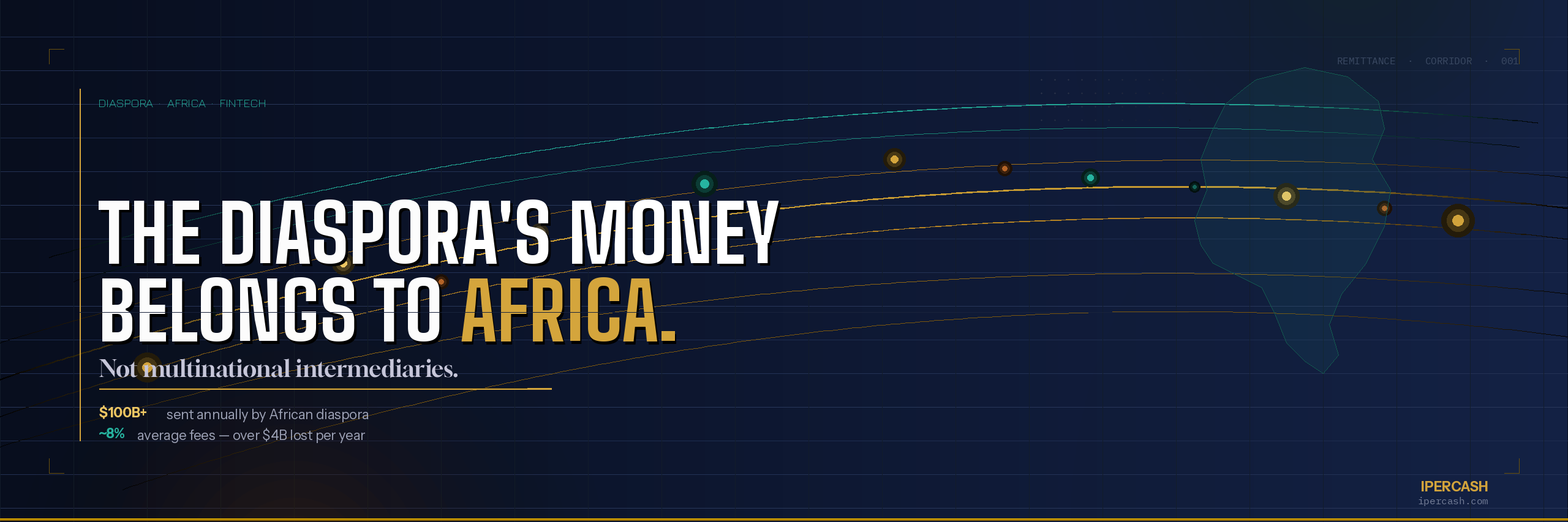
Every year, Africans living abroad send over $100 billion back home. That figure dwarfs foreign aid. It exceeds most countries’ tourism revenue. It keeps families fed, school fees paid, and small businesses running.
And yet, a significant slice of that money never arrives.
It gets absorbed quietly and predictably by the infrastructure built to move it — wire fees, exchange rate margins, correspondent bank charges, and platform commissions stacked on top of each other. The World Bank estimates the average cost of sending money to sub-Saharan Africa still hovers around 8%, one of the highest corridors in the world. On a $300 transfer, that’s $24 gone before a single franc, naira, or shilling reaches anyone’s hands.
The question worth asking is, ‘Who built this system, and who does it serve?’
A System Designed for Extraction, Not Development
The traditional remittance corridor to Africa was not designed with African families in mind. It was designed around correspondent banking networks – a chain of financial institutions, each taking a cut, each adding friction, each slowing a transfer that should take seconds into one that takes days.
Western Union, MoneyGram, and their peers built dominant positions in these corridors over decades. They partnered with local agents, locked in exclusivity agreements with banks, and captured the trust of diaspora communities who had no alternative.
The fees they charge are not incidental. They are the business model.
Meanwhile, the recipients — mothers in Douala, farmers in Lagos, and merchants in Dakar — absorb the loss. A remittance of $200 intended to cover a month of groceries arrives as $184. The gap doesn’t feel like a fee. It feels like a smaller family.
What $8 in Every $100 Actually Costs Africa
Scale that 8% loss across the full remittance volume, and the numbers become structural.
African diaspora communities sent an estimated $53 billion to sub-Saharan Africa in 2023 alone. At 8% average fees, that represents over $4 billion extracted from African households in a single year — transferred not to families, but to intermediary institutions headquartered in Europe and North America.
Over a decade, at current volumes and growth rates, that figure runs into the tens of billions.
This is not a minor inefficiency. It is a consistent transfer of wealth away from the continent, disguised as a service fee.
And it compounds. Money that doesn’t reach a family doesn’t get spent at a local market. It doesn’t get saved in a local bank. It doesn’t get invested in a local business. The economic multiplier that remittances could generate inside African economies gets clipped at the border before it ever has a chance to circulate.
Technology Has Eliminated the Excuse
For most of the past century, the cost of international money transfers had a legitimate explanation: physical infrastructure, correspondent networks, compliance overhead, currency risk. Moving money across borders was genuinely complex and expensive.
That is no longer true.
Blockchain technology and stablecoin infrastructure have reduced the marginal cost of a cross-border payment to near zero. A transaction that once required four correspondent banks and three business days can now settle in under a minute on a public ledger, with full transparency and no intermediary capturing a margin along the way.
Mobile penetration across Africa has reached the point where the recipient side of the equation is already solved. Over 60% of adults in sub-Saharan Africa use mobile money. The infrastructure to receive, hold, and spend digital value exists. What has been missing is a remittance corridor that takes advantage of it — one built to pass savings to the sender and recipient, not to a fee-collecting intermediary.
The Diaspora as an Economic Force — on Its Own Terms
There is a broader argument here beyond fees.
The African diaspora is not just a source of financial transfers. It is a network of educated, entrepreneurially active people with capital, skills, and deep ties to the continent. When remittance costs drop, more money flows. When more money flows efficiently, diaspora members begin to think beyond survival transfers – toward investment, toward savings products, toward building something.
Every percentage point removed from transfer fees is not just savings on a single transaction. It is a signal that the financial system is finally working for African communities, not on top of them.
Platforms built on this principle — transparent fees, blockchain infrastructure, corridors designed around African mobile money ecosystems — are not just cheaper alternatives to Western Union. They represent a different proposition entirely: that the diaspora’s financial relationship with Africa should be direct, dignified, and structurally fair.
What Needs to Change
Three things have to shift for remittances to genuinely benefit African economies at scale.
Fee transparency has to become standard. Senders should see the full cost — including exchange rate margin — before confirming a transfer. Not after. The practice of advertising a low transfer fee while recovering the margin on currency conversion is a form of hidden extraction that regulators in several markets are beginning to address.
Blockchain corridors need mainstream adoption. The technology is proven. The remaining barrier is trust and familiarity. Platforms that invest in community education — particularly within diaspora communities — will close that gap faster than those that rely on tech alone.
Regulatory frameworks in African markets need to welcome, not obstruct, innovation. Several CEMAC and ECOWAS markets have made meaningful progress on mobile money regulation. Extending that openness to blockchain-based remittance platforms would accelerate the shift away from extractive incumbents.
The Alternative Already Exists
IPerCash was built on a direct answer to this problem. Blockchain infrastructure. Transparent pricing. Corridors built around the realities of African mobile money markets. No correspondent bank chain extracting a margin at every step.
The diaspora’s money belongs to African families. The technology to get it there — intact, fast, and fairly priced — is ready.
Learn more about how IPerCash works → ipercash.com